Loading
Invest.me, a student-designed mobile app concept that helps retail investors make trading decisions by quantifying their intuitions and beliefs into binary buy/hold recommendations.
Who to Listen ToFeeling HopefulActionExploreAchievement
tech
1674 wordspositive tone
Overview
Retail investors struggle to apply what they know when making investment decisions. For this challenge, our goal was to help investors make smarter investment decisions by aligning their values and beliefs with their actions. We ultimately designed an easy-to-use, interactive mobile application that turns what people know into simple, binary investment decisions.
Product Summary
Invest.me is an app that helps retail investors make trading decisions in line with what they know already and gives insight into how well their existing stock purchases align with their beliefs.
Video: https://drive.google.com/file/d/12nH4EVHYKystDc4pC6hKQzTRgyrq15ak/view?usp=sharing
Methodology & Research
We started with a slightly different idea: to make trading easier for retail investors, by pitching them “ready-made” investment ideas they could participate in. Our initial hypothesis was that retail investors eschwe the effort of conducting a lot of research by themselves to generate, research and execute trading ideas, and a lot of the news aggregators and information out there is either sensationalist or outdated.
First, we conducted research on the existing landscape of tools, websites and apps that help retail investors trade. Broadly, there are three types of resources:
- News aggregators. News aggregators, including those for trading specific content (e.g. investment research and stock pick recommendations)
- Trading platforms, that allow for technical analyses and certain screening functionalities that give users technical information on historic performance, financial ratios, investment reports and other metrics.
- Discussion boards. Discussion boards and communities about stock tips, trading strategies. They are generally high on opinion and low on analysis.
- Background explainers. Overall explainers: pages that give content on how markets, asset classes specific stocks will perform.
At the same time, we started interviewing retail investors and asking them as open-ended as we could about their investment experience: what gave them confidence to trade, what held them back. Why they were executing some trades, and not others. How much time they would spend on research, and how knowledgeable they would describe themselves. We used this to gain as good a picture as we could about current user trading experiences, as well as our hypothesis. We learned the following things:
- Most retail investors do not conduct any or very little specific research. Instead, trading ideas come from general media browsing.
- Confidence comes through incubation, not additional research.
- Resources out there are not informative as they don’t connect with existing knowledge. The people we spoke to described the resources above as either too technical, dated, to complex, to jargony, not actionable and, generally, not helpful. This is because users found it difficult to make sense of integrating their own ideas and their own knowledge and information with opinion articles that would argue for or against a specific scenario/stock purchase.
- Historic information is not helpful. Similarly, many of the people we spoke to, sensed that one could not reliably trade on “historic information”, as professional traders will always be faster and competing with them is therefore hardly worth it.
- Giving trading advice might be illegal. We realised that giving investment advice is legally murky territory, and we realised that there was limited enthusiasm to sign up for “other people’s” ideas, that might or might not work out.
- Users value simplicity and ease. Every person we spoke to mentioned that existing solutions were either not helpful or too difficult to use.
- Users have time constraints. Most of all, users do not want to spend the amount of time it takes to seriously do research. One of them, even stopped trading completely, simply because it became too time consuming.
Based on all these learnings, we started to pivot and think anew about how we could best enable retailer investors to make better decisions. We realised that it is not a question of giving access to more information – while it might be out there (albei poorly structured), users are not looking for more information. Instead, they are trying to crystallise what they already know into a “yes/no” decision. Should they buy or should they not?
Our Solution
We then focused our project around this insight – what should users do, i.e. should they buy a certain stock, given what they already know? Rephrased like this, the problem seemed similar to Wahl-o-Mat, a German app that asks users to react to a number of political statements, and then recommends them a party to vote for. Another similar type of solution, are the “What-should-I-study?” questionnaires that ask users about their interests, and tell them which subjects they would enjoy at college.

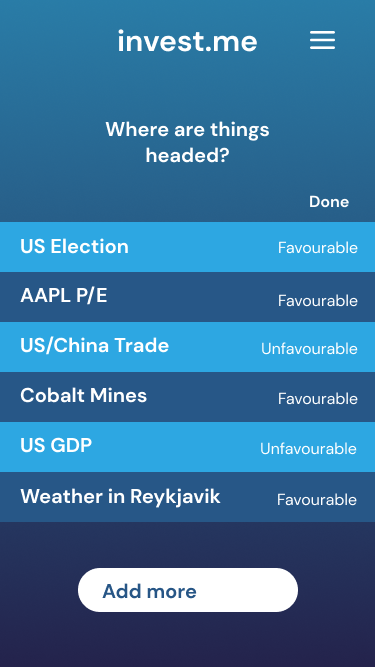
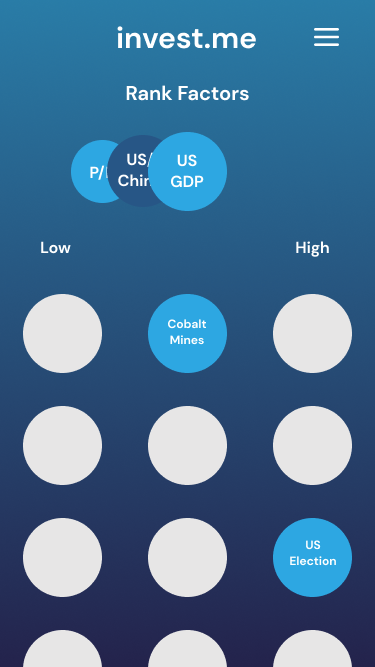
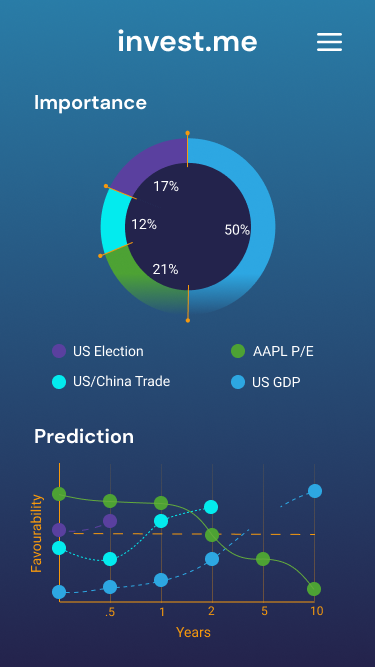
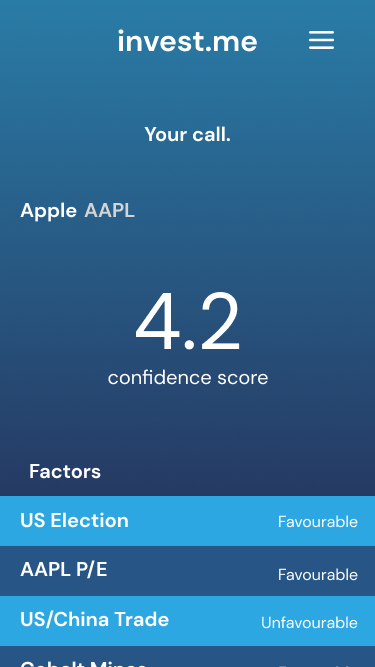
Consequently, we settled around our final prototype: an app that will ask users about which factors they believe will impact the performance of a stock they want to buy. Differently put, we allow users to quantify their intuition and tacit knowledge about a stock, the markets, and any other factor in the world they care about. Users are then asked to give the relative importance of each of these factors, and how they think these metrics will develop over the intended holding period of the stock they had been looking to buy. Based on this input, the app will then calculate whether, if what the user believes actually were to happen, their stock would indeed overperform, i.e. whether their purchasing decision would be consistent with their internal view of the world.
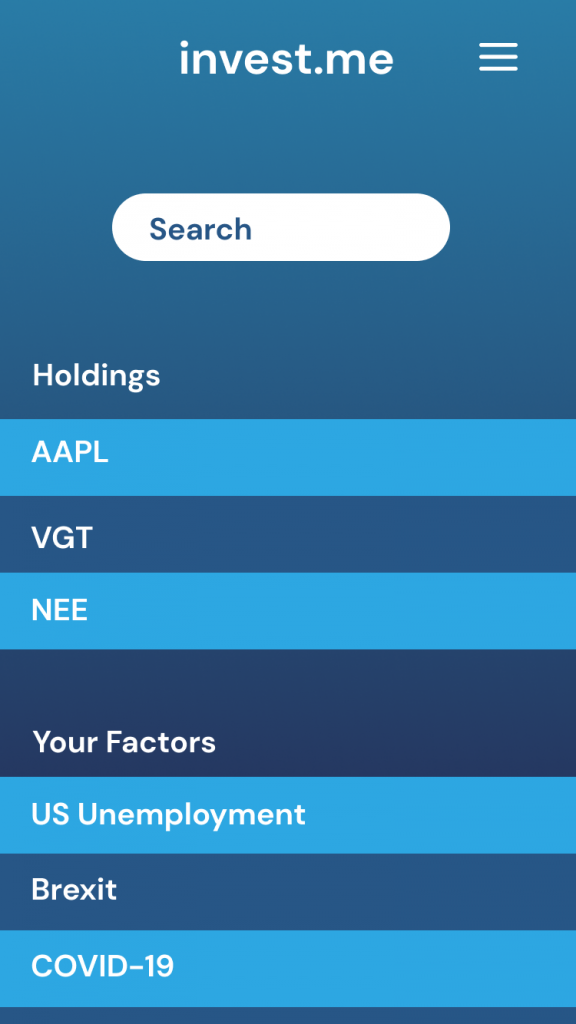
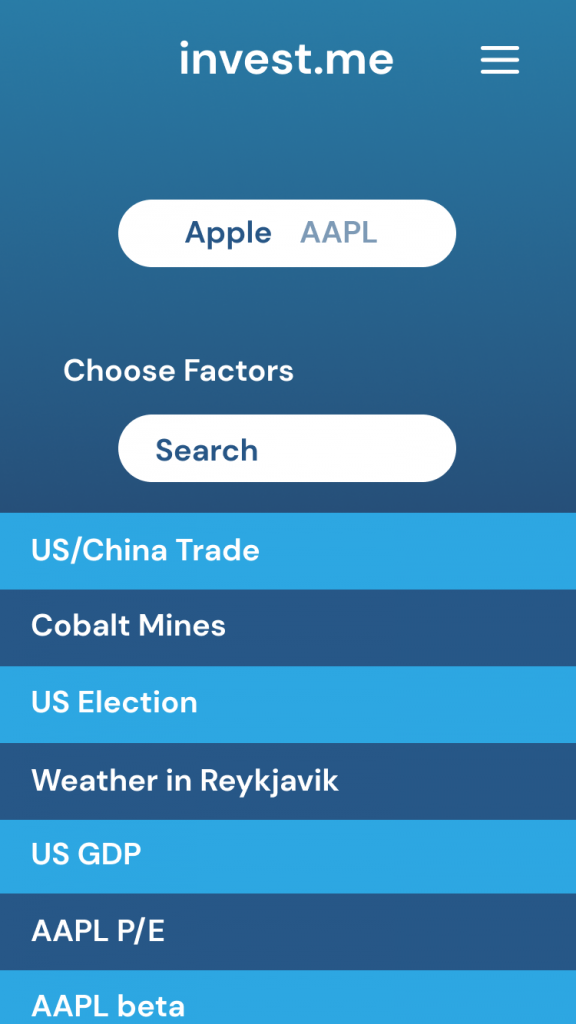
Click on holdings or factors to see all.
Clicking on an individual factor takes you to news stories about that factor.
Clicking on a stock takes you to stock data.
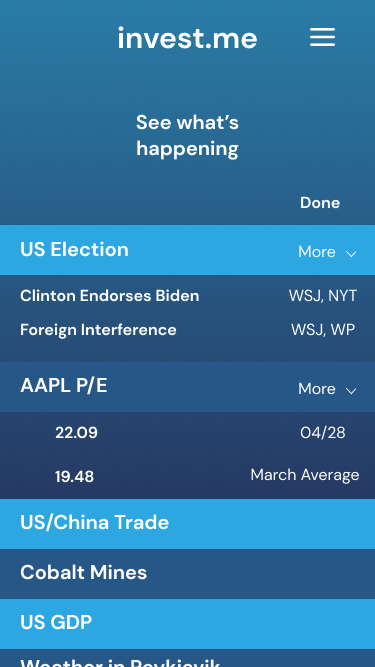
Clicking on “more” could bring you to a page dedicated to news stories/ data on that factor
Clicking on one of the drop downs could bring you to stories from different publications on that specific event
Check off news you are already aware of
Rationale & Design Decisions
When developing the app prototype, we focused on what users had told us they valued: ease, simplicity, and not another time-sink. At the same time, this also created a set of constraints: our app had to strike the right balance between being insightful and personalised, but also being easy to use and effective in summarising and aggregating complex information.
Consequently, we spend a lot of time thinking about the right flow of information, how the user interacts with the app, the way we ask for information and how we display results, to make usability as effortless as possible.
- Engaging & sustaining attention: Through a clean and functional design, we aim to give visceral pleasure by using the app. We considered giving visceral feedback (e.g. via vibration), whenever the app creates a result that is different depending on whether the assessment is positive (“buy”) or negative (“hold off”). This will give the user an intuitive reaction that connects our app with the sense of relief of being able to make a decision.
The clean and clear design language supports the message we are trying to convey to users: clarity, rationality and the end of ambiguity. Their life will get easier and their thinking clearer from using the app. This is why we have only included subtle gamification elements: if our app appears to “gamified” and “fun”, our advice might lose credibility with users, and undermine the purpose of using the app in the first place. - Stimulation: We are aiming to generate a true “wow” effect from the insight we can generate, relying on the concept of awe, to inspire users to “test” their trading ideas. Users will love our app because they get exactly what they want: a customised “yes/no” answer on whether or not they can buy a stock. Moreover, if users realise they do not have a clear perspective on what they think is a key driver, they might be inspired to do more research, in order to “get better numbers” or “prove their hypothesis” about a certain stock. This customisation is key to generate trust and make the information relevant. This “wow” effect, i.e. what the app can “make” out of limited information the user puts together, is a use of stimulation and will hopefully drive our users to tell their friends.
- Ideopleasure: In addition to the above, our app also plays into ideopleasure: the interaction between the user’s ideas of themselves/what they know and what our app is telling them. Because our app is highly tailored to the user’s beliefs, the user will be able to see their knowledge and opinions become tangible, which also lends credibility to the app.
Through all these principles and ideas, we aim to generate a change in behaviour, where users become able to think more systematically in their trades, trade less intuitively (or are at least better able to quantify their intuitions), perhaps even get motivated to conducted specific research to test individual hypothesis (“how do I feel about the future of American consumer sentiment?”) and gain more confidence in the trades they do make, therefore turning into better investors making better decisions. Assuming users are highly motivated to trade better (as it comes with financial rewards), we need to enable them, i.e. increase their ability to do so. If users find they can make better trading decisions through our app, they will be incentivised to use it.
Possible Extensions
Possible extensions of this idea would be the opportunity to track both people’s predictions and confidence over certain factors over time (and how they matched up with actual developments), integrating a more powerful news engine to allow users to conduct ad-hoc research on the spot, and a history of stock trades to track their performance, as well as various data feeds to commonly-analysed metrics. Another fun extension could be an integration into trading platforms, so that users are asked to complete our assessment before they go ahead and buy a stock; in doing so, we could combine our intervention directly on the “trigger”, when motivation and ability are both at its highest.
Link to presentation: https://docs.google.com/presentation/d/1C6gOVHdn2ikTdHjUb6GQzCTp8ulHjewbIVq_Rim57wg/edit?usp=sharing
Link to Figma: https://www.figma.com/file/YtGImGgKVeAUCkWr3v1aNE/Challenge-5?node-id=67%3A46