Loading
Careermatch, a career platform app that personalizes the job search process by matching students and professionals with mentors and employers based on their values, skills, and emotional needs.
Who to Listen ToFeeling HopefulActionExploreAchievement
service
1253 wordspositive tone
Prototype: https://pr.to/9TFU8S/
High-Res User Journey:
https://drive.google.com/file/d/0B_QsY1fvTzcOMjV0OGlqYjMyckk/view?usp=sharing
Challenge: Since Keith and I are both students about to graduate this May, we decided to focus Challenge 6 and 7 on an experience that is pretty unpleasant for most people: the job search process. To start, we asked a simple question — how do people make decisions about what job they want, and whether to accept an offer of employment or not? Do they make good decisions based on the information they have? How might we help people make better decisions about where to work, and to also make the process of deciding where to work more enjoyable?
Hypothesis & Survey Results: We talked about our use of job search platforms like LinkedIn and Glassdoor, and whether they were effective and enjoyable to use. We hypothesized that for others, both LinkedIn and Glassdoor were effective for practical job search functions like finding and browsing job posts, determining what the salary might be for a position, and so on, but not effective for helping people make good decisions about where to work based on their values, needs, and emotions, such as:
- The need to discover what their ideal job is and how to land their ideal job
- The need to feel like they are utilizing their strengths
- The need to feel like they are valued within an organization
- The need to feel like what they’re doing matters in the larger scheme of things
- The need to feel like they are properly rewarded or recognized for their contributions in a fair and equitable way
The above hypothesis was validated by the survey we conducted.
We also hypothesized that LinkedIn and Glassdoor are not enjoyable to use, and therefore people use them more out of necessity than desirability. This hypothesis wasn’t validated, as both platforms made the majority of survey respondents happy. Our assumption is that LinkedIn makes people happy because of its social networking component, and that Glassdoor makes people happy because it provides people with transparency on salary and what it’s really like to work somewhere.
Another insight from the survey was that people are using a variety of methods beyond LinkedIn and Glassdoor in the career exploration and job search process, including:
- Obtaining advice from professors, prior managers, school career counselors, etc.
- Using school-related career search platforms such as Career and HIRED
- Going on company websites or searching on Google
- Using other career apps such as MediaBistro, The Muse, Indeed, USA Jobs, etc.
Additionally, we asked respondents what their ideal job is, and their answers were insightful. While some of them did not know, a few others defined their ideal job not by title but by values and needs such as “a career with continual growth”, “a job where I can work creatively and collaboratively”, “high autonomy”, etc. This indicated that while people care a lot about factors beyond title, salary, and job functions, current platforms don’t address these needs. Lastly, one respondent indicated that “any job search that included personalization to help you achieve skills you are missing would be very appealing.”
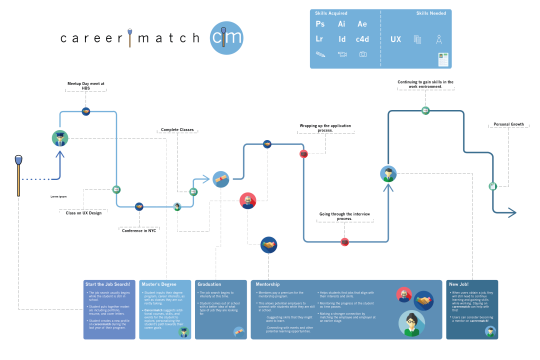
User Journey: We decided that our platform would need to help users do three main things:
- Sort through all of the career options out there through an algorithm that takes into account the user’s education, interests, and skills
- Prepare for the career that they want by suggesting mentors to reach out to, events to attend, courses to take, skills to gain, and so on.
- Make informed decisions about where they should work based on their values and emotional needs.
We decided that one thing all the current career platforms don’t do (or don’t do well) is to help users transition between school and career. Therefore, on careermatch, the user journey begins while the student is still in school. A few functions that help ease this transition and ensure that what students are doing in school purposefully lead them towards achieving their career goals include:
- Based on the student’s career goals and current profile, careermatch suggests courses the student should take before they graduate.
- Careermatch also recommends faculty mentors who are knowledgeable about the industry the student is interested
Every time a student reaches out to a mentor, attends an event, takes a class, etc, careermatch keeps track of their actions and progress and further personalizes the student’s professional development journey.
The user journey continues after the user starts their first job after graduation, since as employees people still need and want to continuously grow and learn.
Other users, besides students, are professionals and employers. Employers use careermatch to find talent for their companies. Similar to the way that careermatch personalizes the job search for students and professionals, it personalizes the talent search for employers. Employers input information such as what education and skills needed for a particular position, and careermatch suggests people, either current students or professionals, to reach out to. Employers also have the option of signing up as official mentors for students/professionals and are paid for the mentorship that they provide. This is an opportunity for employers to tap into talent as well as build a good reputation for themselves. In this way, careermatch acts as a matchmaking service for employers and job searchers.
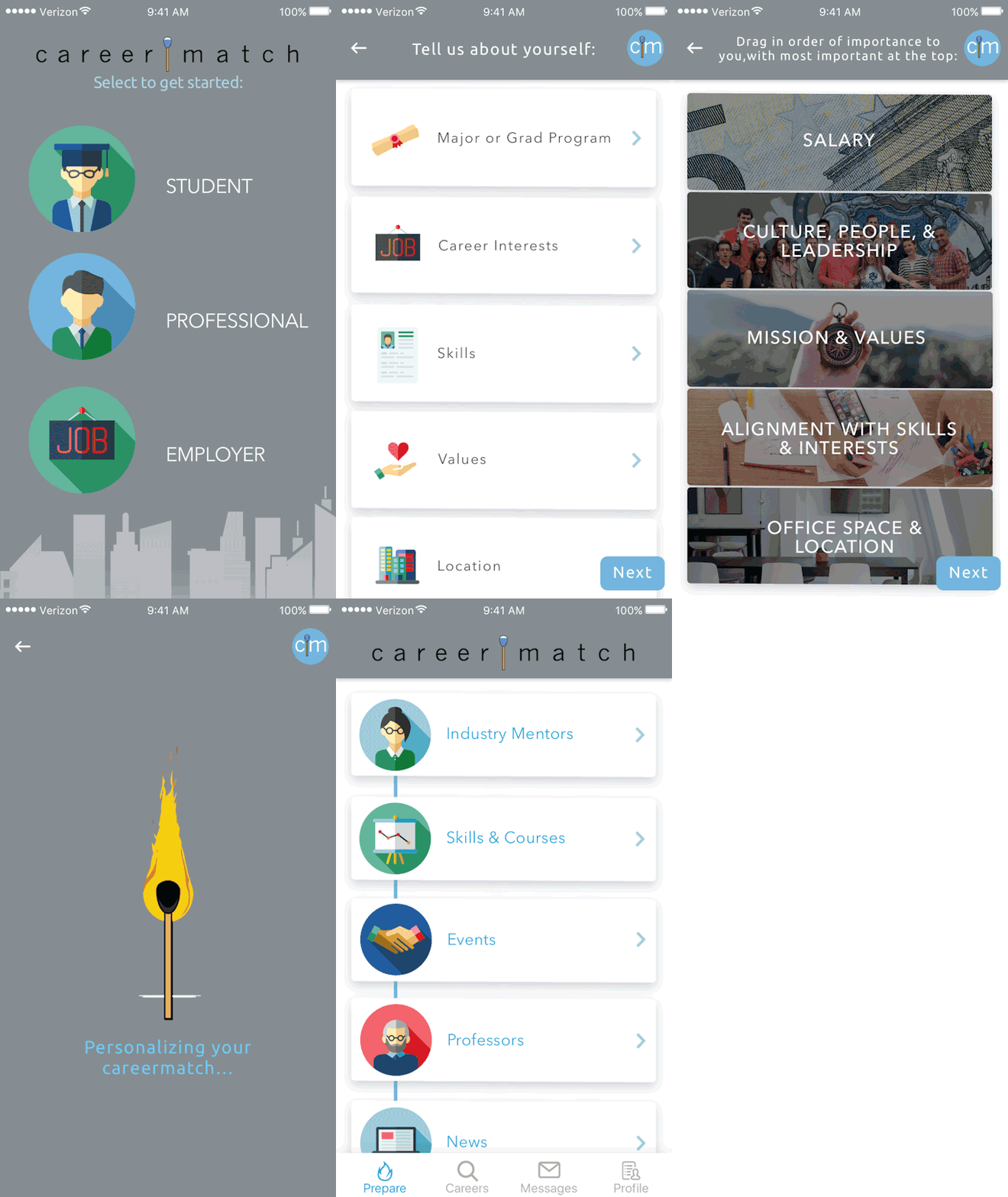
App & prototype design: The design of careermatch is simple and not too serious. We found the design of LinkedIn and Glassdoor to be corporate and stiff, which doesn’t appeal as much to students. (In comparison, we found the design of other sites like MediaBistro and The Muse to be more hip and fun, and thus the experience to be more enjoyable). In addition, platforms that require users to input a lot of information are usually cluttered and uneasy to use; therefore, careermatch purposefully allows users to input information needed to personalize their experience in a simple and dynamic way. The prototype walks users through one of the main functions of the platform:
- The user selects that they are a student among the different target audiences
- The user is then brought to a screen where they can input information about their education, interests, skills, and values
- They choose to edit their ‘values’, and are asked to rank their values by dragging and dropping a series of images
- Next, career match personalizes the experience for the user
Finally, the user is brought to their homepage, where they can navigate between the Prepare, Careers, Messages, and Profile pages.
- The Prepare page suggests ways for the user to prepare for their ideal job
- The Careers page allows users to view companies and positions that match their values, skills, and interests
- The Messages page contains correspondence between users and their mentors. This is where the social networking happens! Non-premium members can still reach out to people who work at companies they’re interested in, but p
remium members receive more tailored and guided mentorship from employers who have signed up to provide the service. - The Profile page allows users to edit their information at any time.
Desirability: Careermatch is desirable because it’s both helpful and enjoyable to use. It offers more utility than current options like LinkedIn and Glassdoor by addressing users’ emotional needs and helping users make better decisions about their careers. Careermatch provides users with a lot of value by personalizing their career search experience, giving users information on how to launch or advance their careers, and matching them with mentors and employers. Finally, careermatch helps students in particular make a seamless transition from school to career.