Loading
A three-segment customer survey strategy for a fashion brand that targets loyal, unhappy, and disengaged customers with exclusivity-based incentives.
Who to Listen ToFeeling HopefulActionAchievementGroup Security
service
755 wordspositive tone
Sample Size: In order to reach a conclusive decision, we will need ~2,500 responses. Ideally we’ll receive >1,000 responses for each of the three target groups. If we expect around a 2% rate of receipt, we will have to contact >125,000 customers, which should be easy to do given that we are a major fashion brand.
Target Groups: Many company surveys don’t target a random and representative portion of their customer base – either receiving feedback from positive or negative experiences. The goal of our targeting is to hear from three discrete groups: loyal customers, unhappy customers, and the customers who have historically had minimal engagement with our brand. As noted in an HBR piece, “the silent majority typically drives the success or failure of a business.” While we agree it is important to engage with the silent majority, it is also key to make sure we align our new line with what our loyal customers want. Acquiring new customers is far more costly than keeping customers. As witnessed with Ron Johnson’s unsuccessful stint at J.C. Penney, it is dangerous for brands to try radically new ideas that overlook the needs of loyal customers.
Group 1 – customers purchasing in-store or online.
- These customers will be excited about their purchase. While in checkout employees will ask customers to briefly fill out a survey. For those purchasing online they will be asked to fill out a survey after completing the order. For these customers, the survey will help them get excited about the next line of clothing being released and also give them a chance to give their input.
Group 2 – customers who are returning items in-store or through online return.
- The goal of this targeting is to show these customers how important they are to the brand by recognizing the fact that they are returning items and also asking them to help design our next line so that in the future they won’t be returning items. The form of the survey will be either in-person upon return or via an email that confirms receipt of the returned item.
Group 3 – customers who have bought <=2 items within the past twelve months
- These are the customers who find the brand somewhat appealing but haven’t yet fallen in-love with the fashion line. These customers will be incredibly important to listen to as they represent a major opportunity for future success. If customers in this group like the future product x
Incentives and Messaging: While it is commonly predicted that higher incentives lead to higher performance, if incentives are too small they can have an undesired effect. It is therefore that we won’t be offering a $100 cash prize for the winner since given the odds of winning – <.1% the incentive won’t be strong enough. We’ve decided to offer something that can be a powerful incentive: exclusivity. By taking the survey, we’re offering participants the opportunity to view and purchase clothing from the new line before the brand opens it up to the public. We’ve seen a number of brands due exclusive promotions that have had large success in creating curiosity, i.e. the chipotle burrito card. The incentive will take on two forms, the first is that customers will hear about our changes first and be given VIP access to new clothing. The second focuses on brand engagement and customer loyalty, by investing in the survey and providing input to the next line of clothing, customers will have their voice heard. In each of the campaigns to the three target group, the overwhelming message will be on the importance of giving customers a strong voice. This will come in three ways: giving a voice to continue love of the brand, giving a voice to help fix what isn’t working, and thirdly to give a voice to figure out what would lead to higher engagement.
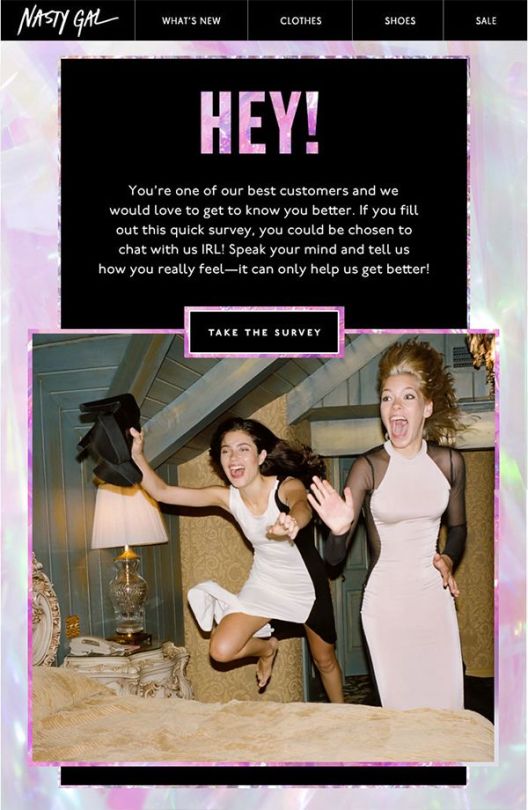
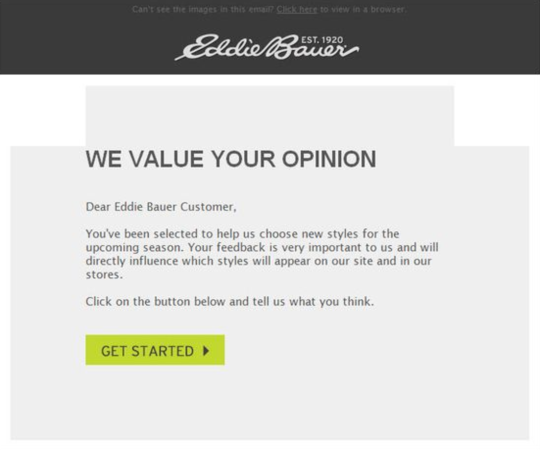
Core action: The core action will be getting customers to take the survey. In the long-run though we will measure what percentage of customers who take the survey go on to buy products during the exclusive shopping opportunity to measure how powerful exclusivity was as an incentive. The following examples are similar to the type of campaigns we would run:
Sample Messaging:
Sources:
https://www.entrepreneur.com/article/252780
Gneezy, Uri, Stephan Meier, and Pedro Rey-Biel. “When and why incentives (don’t) work to modify behavior.” The Journal of Economic Perspectives 25.4 (2011): 191-209.
http://business.time.com/2013/04/09/the-5-big-mistakes-that-led-to-ron-johnsons-ouster-at-jc-penney/